Sunday, August 28, 2016

Life's journey among the isles

A cairn on the abandoned island of Mingulay,. Beyond are the islands of Pabbay, Sanday, Vatersay and Barra.

BOOK REVIEW: My Journey by Elizabeth Campbell (Acair Books)

Elizabeth Campbell's autobiography
Although only 67 when she died, and having spent the majority of her days in one of the remotest parts of the British Isles, Elizabeth Campbell saw the world transformed during her lifetime.

Born in 1913, she grew up in a community where homes had bare dirt floors and where shoeless children were the norm. She witnessed the mixture of marvel and trepidation that greeted the appearance of the first car on the island of Barra, and she could recollect the famous shipwrecking of a cargo vessel loaded with whisky, as well as the arrival on the island of gramophones and finally electricity.

Campbell was a teacher all her life, mostly in Barra and Vatersay, but also in Glasgow.

She quietly lived most of her life in the Western Isles. In 1977, the year before she retired, she was bestowed the honour of MBE for services to the community of Vatersay, and she travelled to Buckingham Palace to receive the award from the Queen Mother.

In 1980 she completed writing her autobiography, Air Mo Chuairt [My Journey], in her native Gaelic. She died the following year. In 1982 the book was published. Now, 34 years on, an English translation has been released for the first time.

My Journey reveals what it was like to grow up and live on one of the islands of the Outer Hebrides. Campbell chronicles her life from childhood, when her father was away serving in the First World War, through her school years, the dances and ceilidhs, the weddings and how it was to walk the length of the island to reach the main town of Castlebay.

The shipwrecking of the SS Politician off the coast of the nearby island of Eriskay, an event later immortalised in the film Whisky Galore, is also recollected by Campbell, who was then in her late 20s.

She chose teaching as her profession and it was a career that lasted for 40 years.

In My Journey she does a tremendous job of creating a sense of place, setting and time, giving voice to her recollections in a natural, everyday manner. Indeed, reading the autobiography almost feels like being in Campbell’s company, sitting in her front room and listening to her stories.

Among the tales is an encounter with an elderly, former resident of Mingulay, the remote island to the south of Vatersay that was abandoned in 1912. Campbell does a fine job weaving in enlightening facts about the history of the islands, including stories of Mingulay.

Ruins at Uidh on Vatersay
My Journey takes readers back to a world far removed from the often frantic one of today. Community spirit was all encompassing, traditions were well observed, and even though worldly possessions were scant, the people were happy.

The children of the villages went barefoot, they had no choice. When new tackery boots arrived they would compete to see who could keep theirs in the best condition for the longest time. "Often a young girl would have them on a table beside her bed at night," writes Campbell in one of many touching vignettes that jump from the pages of My Journey.

The first car arrived in Barra in 1926, of which Campbell said: "People were truly amazed watching it (nearly lost the two eyes). If an old man or old woman was walking on the road, on seeing the car miles off they would dive off the road and run up on the hillside as fast as they could."

There are a few moments that are touched upon more than once, and therefore appear to carry extra poignancy for Campbell. One is the striking image of a boy declaring his independence from school life, in the days when children were allowed to leave school when they turned 14.

"One day a young 'hero' was fully ready to leave school the very day of his birthday," recollects Campbell. The bell rang and the schoolmaster called the boy to join the others inside the school grounds. "But instead the lad gave a speech informing the whole world that he was this day in a heaven of his own, free from all the restrictions that did not appeal to him. Thus he stood with one hand on his hip, the other raised upwards to the sky, and happy as one ever seen he bounded off over the hill of the bay. But that did him no harm. He got on well in the world, though his life was cut short. Each time I see that bridge, the memory of the 'Highland Fling' comes back to me."

Campbell's descriptive and highly accessible writing style is as much of a joy as the tales she relates. A good example is the story of George, who was the first to bring to Barra a gramophone player, complete with an elegant long horn.

"We thought the voice came from the next world! George used to take it on the rounds to each and every house in the village, and our group always followed him. Those who could not fit inside the house were like leftovers outside the door."

Later on we hear about that arrival of electricity in Barra in 1967, soon followed by television - or "the box".

Although there are moments when the book becomes almost a stream of conscience as anecdotes finish abruptly and a new thread is taken up, these instances are few and far between and hardly detract from the otherwise compelling narrative.

Kisimul Castle, in the harbour at Castlebay, Barra
During Campbell’s lifetime Gaelic was widely spoken across the Western Isles, but from an early age she was aware that it was viewed as "the language of the working people" in comparison to English. However, it is abundantly clear that Gaelic was, and is, one of the most important bonding elements within the island communities. And Campbell states her belief that even in the future native islanders "will allow no one under the sun to push Gaelic backwards out of the way".

Towards the end of the book, as she reflects on her life she wonders if the modern generation are as happy and fulfilled as she was in her youth.

"I don’t see young girls picking flowers as they did in my day. Neither do I hear young people complaining of lack of money. There is no word now of working hard all week to earn the shilling entrance fee for the dance. Everything is so easy for them, perhaps they are just as happy in their state as we were in our youth, but it is difficult to believe that," she writes

Though it was more than 50 years distant at the time she completed her autobiography, Campbell remembered the opening of the Northbay Hall in the late 1920s, and the first community dance held there and the happy steps and the noisy clatter on the floorboards.

Over the years there was plenty of joy and some hardships, but even the latter - such as clambering on hands and knees across rocks and seaweed to reach the little ferry that linked Barra and Vatersay - had an endearing edge.

My Journey is a pleasure to read with its vivid documentation of a world now mostly vanished, and is a reminder of how things once were, and how important it is to enjoy life’s journey through the good times, the hard times and all manifestations in between.

Air Mo Chuairt by Ealasaid Chaimbeul [My Journey by Elizabeth Campbell] is published by Stornaway-based Acair Books.

The first half of the new edition features the original Gaelic version. It is followed by a supporting English translation, compiled by another Barra native and teacher, Mary Flora Galbraith. Galbraith has done a sterling job bringing the book to a wider audience and preserving much of the flavour and quirks of the Gaelic original in the translated version, which includes numerous enlightening footnotes.

Saturday, August 20, 2016

Love the song #1: Stronger - Kelly Clarkson

Kelly Clarkson in a video dance scene for 'Stronger'. Guitarist Cory Churko is just over her shoulder
This is the first in an occasional series where I'll highlight a song that particularly inspires, uplifts or simply grabs me. The tunes will appear in no particular order.

First up is Stronger (What Doesn't Kill You) by Kelly Clarkson. Although it was released five years ago, I only recently came across it for the first time when, by chance, I heard a snippet of it being played as incidental background music.

Kelly Clarkson was the first winner of the American Idol TV talent show in 2002, and despite some obstacles along the way she went on to forge herself a very successful career,

Stronger is an infectious, rock-anthem whirlwind. Clarkson's vocal delivery captures the empowering essence of the song's theme. Yes, the lyrics don't go deep, but then they don't have to. The message is simple, pretty much universally understood, and delivered with a stomping, punchy verve.

The song features some great guitar playing by Cory Churko, who is a mainstay of Clarkson's band and is also a key figure in Shania Twain's current backing band. Churko can be seen in the official video, both as a member of the band and in the flash mob dance scene led by Clarkson.

The video is as uplifting and fun as the song, with some great choreography for the aforementioned flash mob dance scene, which includes a few light-hearted kung fu fighting moves from Clarkson. The video is interspersed with clips submitted by fans doing their own dance interpretations of the song. Both as a song and video, Stronger is a feel-good wonder.

Here is the video:

Sunday, July 10, 2016

Farewell to "Mr Happy Man"

Johnny Barnes with his statue on East Broadway.
Bermuda awoke on Saturday to the news that Johnny Barnes, "Mr Happy Man", had died at the age of 93.

For the last 30 years Mr Barnes has wished commuters a happy day, waving, blowing kisses and saying "I love you" as he stood next to the main roundabout junction leading into the capital city of Hamilton.

Since retiring from work, he has spent the last three decades getting up in the middle of the night to make his way to the roundabout by foot, in time to spread greetings of unconditional love to commuters.

It mattered not who you were, for Johnny the message was "one love". He'd wave, blow kisses and call out "I love you" continuously from 4am to 10am every weekday. He never missed a day, unless a hurricane was blowing or he was ill.

In fact, shortly after I arrived in Bermuda I saw the panic that gripped the community when Mr Barnes was not seen at his usual perch for three consecutive days. The radio chat shows were full of it, the phones at our newspaper office were ringing with concerned callers wanting to know where was Johnny.  As it turned out, it was one of the rare occasions when an illness prevented him performing his daily ritual. But he was back in place a few days later. Panic over!

It was in 1986 that Mr Barnes began his astonishing, virtually unbroken 30 years as an ambassador for love and happiness. However, he had been making occasional roadside gestures of goodwill to all-comers for many decades before, even as far back as the late 1940s when he worked on the now long-vanished Bermuda Railway.

In 1998 a bronze statue of Mr Barnes was created by artist Desmond Fountain and for the past almost 20 years has stood about 100 metres further along the East Broadway approach road. The statue wonderfully captures his open embrace for all.

With Mr Barnes at his greeting spot in 2009
When I first saw the statue I thought how unique, but remarkably fitting it was to have such an honor for a man who was very much still around and continuing to have an uplifting impact on people's lives. Of all the quirks of life in Bermuda, Johnny Barnes and his morning greetings was one that has always deeply resonated with me. And though the East Broadway roundabout has never been on my usual commute route, it always felt special when I did happen to pass through that way and received a fleeting greeting from Johnny.

I twice stopped to chat with Mr Barnes. His friendly, effervescence was infectious. On one of those occasions he handed me a postcard, featuring a photo of himself with the Desmond Fountain-created statue (pictured above), and a simple message on the back. It was a greeting card he handed to many people - islanders and visitors alike. The message read "Johnny Barnes. I love you. God bless you."

In 2011, American filmmaker Matt Morris made an award-winning 10-minute documentary about Mr Barnes, fittingly titled Mr Happy Man.

The following year, Mr Barnes fell at his regular spot. At almost 90, he struggled to get back on to his feet, and this incident led to calls from the public for a seat to be installed for the local legend. A tiny wooden bench, big enough for one, along with a wooden handrail were duly put in place for Mr Barnes.

As an example of the deep affection with which Mr Barnes was held by many a newspaper article in The Royal Gazette reporting the passing of Mr Barnes and featuring tributes, published on Saturday morning, had been "liked' almost 6,000 times on Facebook by Saturday evening.

Bermuda's Premier, Michael Dunkley, was quoted as saying Johnny Barnes was "a remarkable, original man whose life gave life to the love we all have in our hearts, and who, from his roundabout perch each morning, expressed that love to all who passed by — friend, acquaintance, stranger, it did not matter, because Johnny Barnes embraced the human race".

That loving embrace that Mr Barnes showed the world lives on. It is reflected in the statue on East Broadway, and in his own words as he explained to movie maker Mr Morris his reasons for engaging with people in the manner that he did. (see video below).

Farewell, Mr Happy Man.

Sunday, June 19, 2016

Reflecting on Glastonbury Festival 1987

Tents at the Glastonbury Festival in June 1987. Some 60,000 (likely 100,000 unofficially) slept under canvas

Car henge - installation art in a field
No one said the Glastonbury Festival would be easy, but then no one had to. I was intent on experiencing the revered and much storied event, and if that meant hitch-hiking 100 miles with all I could carry crammed into a rucksack, so be it.

What lay ahead was an adventure I would not forget. It was 1987 and the Glastonbury Festival was about to undergo a watershed moment in its evolution. And by watershed I'm not referring to the "right on cue" deluge of rain that assisted in turning the fields into muddy quagmires, assisted by the trampling feet of the 60,000 official attendees and tens of thousands of gatecrashers and fence jumpers.

Actually, in the history of the Glastonbury Festival, 1987 was not one of the famed wash-out years, however, mud was a hazard thanks to at least one day of abundant "liquid sunshine".

In a few days' time Glastonbury Festival 2016 will get underway in Somerset, England, marking the 34th edition of the music and cultural gathering that has a history spanning 46 years. This made me reflect on my own Glastonbury experience, when I attended for the first (and so far only) time.

Accompanying these words are photographs I took at the festival, capturing elements of the travelling community, the music fans and alternative lifestyles that mingled, potpourri-style, like a lost in time, raggle-taggle nomadic tribe scattered across the fields of ancient Avalon.

In 1987 the festival was considered well-established, although looking back from the perspective of today it was still in its infancy, being held for only the 11th occasion.

One of the previous ten festivals had been an unplanned, spontaneous event in 1978 when a group of bedraggled New Age travellers, washed out on their annual summer solstice pilgrimage to Stonehenge, arrived at Glastonbury with the mistaken belief that a festival was going to take place. There had been two previous events, in 1970 and 1971, but then nothing. The travellers of '78 were given access to the old festival site. A makeshift stage was erected, and with power from a portable generator a headliner-free festival was held. The event lasted about two weeks, there was no admission fee, and it was attended by an estimated 500 people.

That unplanned festival resurrected interest in the Glastonbury Fayre - as it had been known in 1971 - and an official festival was organised in 1979. Since then the Glastonbury Festival has been held almost every year, except for a few sporadic 'fallow years' when it is given a miss to let organisers rest and allow the fields a chance to recover. The most recent fallow year was 2012.

Music could be found in every corner of the sprawling festival site in 1987
Back in 1987, unlike today, festival tickets did not sell out within an hour of going on sale. Most people would wait to see which artists were lined up before buying their tickets. For others, going to Glastonbury wasn't so much about the music but was a kind of right of passage, something that beckoned in their teenage years and early 20s - a milestone along the journey from youth to adult, and an opportunity to escape the humdrum of everyday life and experience a liberating, alternative freedom - albeit only for a matter of days. For me attending the festival was a bit of both.

Home comforts were forsaken. Although officially a three-day festival, most people arrived a day early and left a day after the music was over; sleeping in tents, come rain or shine. As noted, Glastonbury '87 had its day of deluge and muddy fields to squelch through. The toilets were little more than farmyard latrines, open to the sky and with the wind whistling around your feet.

Food supplies and provisions were carried onto the site (or in a vehicle if you were so lucky). On site there was freshly cooked food for sale, from burgers to vegetarian to exotic Asian dishes. Music played most of the day and night (and getting to sleep while an illegal sound system was pumping out a beat somewhere in the valleys was just one challenge of life in the festival's tent metropolis).

My clearest memories include Ben E King singing Stand by Me, and then saying that as John Lennon had once sung his song he would perform one of Lennon's. He then launched into a beautiful, soulful rendition of Imagine that floated across the sunny Somerset countryside.

Then there was Los Lobos with their infectious hit of the moment La Bamba - played twice for good measure. Another unexpected standout performance was the new-to-the-charts singing duo The Proclaimers, who delivered a sizzling set to delight the audience that sat on the grassy slopes in front of the Pyramid Stage to check out the day's opening act.

Robyn Hitchcock & The Egyptians, and Michelle Shocked, were two of the second stage performers I sought out, while the main stage headliners of New Order, Elvis Costello and Van Morrison all delivered memorable moments. New Order's Friday night slot included the first live performance of their future smash hit True Faith and was accompanied by a much-anticipated laser show. The laser show was inspired, heightening the feeling that the festival was being played out in a parallel reality.

In the distance is the main pyramid stage at the Glastonbury Festival, June 1987


The 1987 festival was a watershed moment in as much as it was the last time the festival was truly a self-policing, communal gathering of people from every strata of the wider community. It was an event held essentially outside the constraints of regular authority, looking after itself with its own security team. That's not to say there were not minor crimes on a yearly basis, but by 1987 the winds of change were blowing and the regular police force was invited to enter the sprawling site on an observer-only basis. From 1989 onwards (1988 was a fallow year) the regular police force has been part of the festival's security arrangements.

The festival has continued to change and evolve over the past 29 years. Today it attracts upwards of 160,000 people. It has a more corporate identity, through sponsorship and the structure of its organisation. And it enjoys almost saturation media coverage, including comprehensive televised coverage of performances. As for ticket prices, they have gone from around £30 to about £230 today.

As time has marched on the rough edges of the Glastonbury Festival have been smoothed. However, I'm sure it remains a vital and uplifting experience for those who attend, and is still significantly removed from regular day-to-day life, if perhaps to a less dramatic degree than it was once. And no doubt today's festival-goers will feel a pang of sadness when it is all over and it is time to leave the empty fields on Monday morning, having been immersed for many days in that alternative world where there was an overwhelming acceptance of and openness towards others, and where anything seemed possible. That's the magic of the Glastonbury Festival.

--------------------------
Click below to watch a silent, super 8 home movie filmed at the Glastonbury Festival in 1987 showing the day to day activities of one group of friends at the event. I don't know who these people are, but this film nicely captures the reality of attending Glastonbury in the mid-1980s, and one of the group, seen on the thumbnail picture, is wearing a Robyn Hitchcock t-shirt identical to one I owned at the time.


-------------------------
And click here for New Order's first live performance of True Faith, as heard at Glastonbury 1987. The video will automatically begin at the start of the song.

Sunday, May 1, 2016

Happy music from the edge of the world

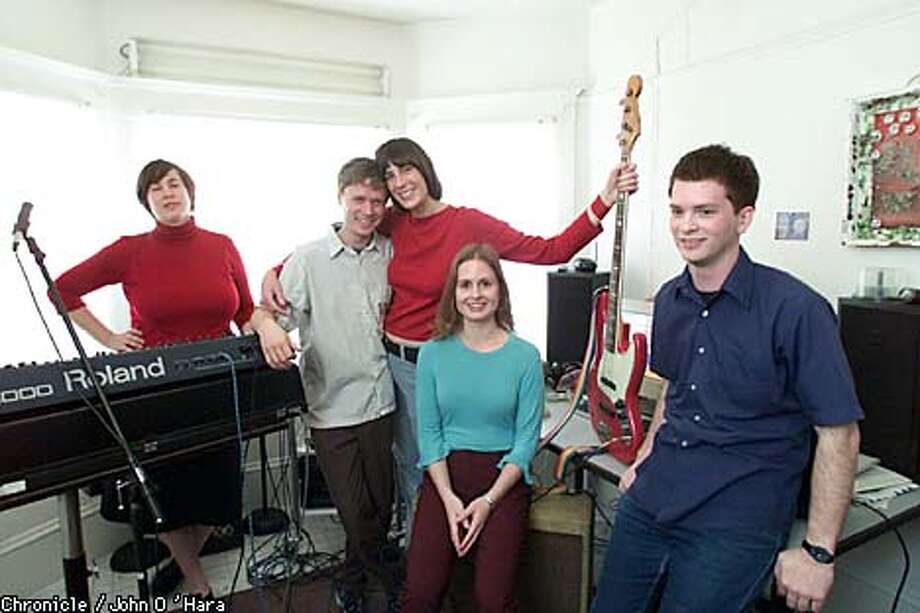
Call and Response in 2001, around the time of their eponymous album
Call and Response in the early 2000s. Their last show was in 2005
Little-known band Call and Response are now long gone as a musical unit, but the freshness and joy of their West Coast sound resonates today as it did at the turn of the millennium when it was recorded.

Their sparkling clean sound, driven by some of the sweetest melodies and harmonies to be found outside the 1960s has a timeless quality.

The band hailed from Santa Barbara, California, before making San Francisco their home. They were never signed by a major record label, but put out a number of recordings through independent labels. Their debut single, the delightful Rollarskate, was released in 2000. It was followed a year later by their first album, which was named after the band.

At the heart of their music was a collaborative approach to dreaming up catchy melodies, together with the use of some instruments that would have been considered retro even in 2000, and the projection of an unswerving sunny disposition that by all accounts reflected exactly who they were.

Organist and singer Carrie Clough and main keyboardist Simone Rubi were both classically trained. Also in the band was innovative guitarist Dan Judd, bassist Terri Loewenthal, and Jordan Dalrymple on drums. Most of the group could competently play a variety of instruments.

The guitar, bass and drums are often heard layering across one another and striking unexpected time signatures that give an otherwordly feel to the music. Add in vocal harmonies, together with a variety of Moog and analogue synthisisers and organs - including a wurlitzer - and you have the ingredients to make a West Coast sunshine sound with elements of pop, electronic and "bubblegum funk".

As for the happy vibe, that was explained by Rubi during an interview with the Tucson Weekly in November 2001. "You can hear a kind of longing in the songs, but then the lyrics are really happy. Especially at a time with all this hip-hop/metal stuff, it's so over the top it's almost obscene. So we were trying to bring back the idea of beautiful music again," she said.

It was while sitting in an independent, arthouse-type cinema in Santa Monica, California, that I first took notice of Call and Response. It was 2001, and I was waiting to see a movie in the Laemmle Monica Film Center on 2nd Street. At that time the theatre would play music during the pre-show wait, giving exposure to new, independently-released music.


The aforementioned Rollerskate and California Floating in Space were the two Call and Response tracks included in the pre-show loop. Both songs jumped out with their dreamy lightness and that puzzling mixture of new and retro sounds. Perhaps tellingly, I can no longer recall what film I had gone to watch that day, but those two songs left an impression, and in time I tried to track down information about the band.

Call and Response in concert
While the music of Call and Response was once difficult to find, happily it is now widely available for purchase and digital download. I highly recommend their first album, which drifts along with a freshness and joy, and a timeless mystique - music that belongs in the here and now, but references a soft focus mixture of fondly recalled yesteryears.

In a world that feels increasingly smaller due to faster and easier global travel and the instant connectedness of the internet, it is worth remembering a time only a few centuries ago when "old world" settlers first arrived in North America. The final frontier was the western horizon and the great unknown that lay beyond. Gradually the final frontier was pushed further westward until the Pacific Ocean was reached and the "new world" had been explored.

However it can be argued that California, at the western edge of continental USA, remains psychologically the edge of the world, a place where frontiers of innovation and thought continue to be pushed back - from the digital dynamism of Silicon Valley to the movie wonderland of Los Angeles.

Therefore, it is fitting that the music of Call and Response, which so transcends time and place, came from California's coastal fringe. It is indeed happy music from the edge of the world.

Click below to hear Call and Response's catchy The Fool


For further reading:
Call and Response at the SXSW festival in Austin, Texas, in 2001.
Pre-album release article (SF Weekly, January 2001)

Update (June 18, 2016): Below is what may be the only live performance of Call and Response on YouTube. It features a few short interviews with band members backstage, and wraps up with the band on stage playing Stars Have Eyes, a song from their debut album.

Sunday, April 3, 2016

My UFO encounter (1978)

This artist's illustration is a good approximation of the
delta-configuration of lights seen in the Leicestershire
sky on the evening of October 23rd 1978
Many people have a UFO story somewhere in the lives. Mine dates back to 1978, and it remains one of the most widely-reported and still unexplained sightings over the skies of the English Midlands.

Although the event is now almost four decades in the past, this recollection is based on a journal piece I wrote during the 1990s.

In October 1978 I'd just started high school and lived in a village called Measham, on the fringe of the counties of Leicestershire and Staffordshire. Our house had a good-sized back garden and our neighbours, a couple called Jayne and Stuart, had two large dogs that were normally quite well behaved. One was a German Shepherd called Elsa, the other was called Jason.

The evening of October 23 was unusually warm, which meant a lot of people were outdoors. I was in the rear garden when a bright light caught my eye. It was in the night sky to the southeast, roughly where the town of Hinckley lay about 15 miles distant. At almost the same moment Stuart, who was sitting out in his garden, asked what was the unusually bright light in the sky.

Being relatively familiar with the night sky, and the appearance of Venus and Mars at dawn and dusk, I mentioned that it was probably Venus as it was quite bright, and said I'd fetch an old telescope - a slightly dented old mariner's eyepiece that was bulky and made of brass, but was still serviceable.

Looking through the telescope the object did not appear like Venus. Initially it had me thinking that maybe it was a hot air balloon lit from beneath by bright lights. Stuart tried the telescope and was no surer than I. By now his wife Jayne was in the garden and also remarked on the bright light.

Whatever it was, it seemed to be stationary over the Hinckley area. We continued to observe the light as it stayed stationary for what was at least 10 minutes, but could have been twice as long. Then it began to move again, towards our village. It followed a roughly diagonal path from southeast to northwest. As it moved closer the light increased in brightness and it began to appear as more than a single point of light.

With the benefit of the telescope I quickly made out at least three separate lights. But as it got closer there was no need to use the telescope, even with the naked eye it was clear the lights were aligned in a delta configuration; one at the front and two slightly off centre behind.

The object made no sound and moved smoothly and relatively slowly.

What added to the feeling that something wasn't right about these lights in the sky was the reaction of Jayne and Stuart's dogs, they were in the garden and started to bark loudly for no reason and became generally agitated, something which the couple found odd.

As the object got closer the brightness of the lights seemed to dim, but the delta formation remained. Even with the telescope trained on it, it was impossible to make out any structure beyond the three lights. The object glided almost directly overhead in total silence and continued on its way northwesterly in the direction of Castle Donington.

For the remainder of the evening I felt a strange uneasiness. The following morning on the school bus from Measham to Ibstock, many of the schoolkids were talking about seeing the strange lights in the sky.

That evening there was an article in the Leicester Mercury newspaper about a flood of calls to the police and other organisations from people in the Hinckley, Measham, and Ashby-de-la-Zouch area who wanted to know what the lights were.

The following day, in a second report, the same newspaper said that the number of callers had increased to more than 100 as more people reported seeing the same unusual lights in the sky. There was no explanation from the authorities, and traffic control at the East Midlands Airport, near Castle Donington, said they had no flights recorded at the time the lights were sighted.

To the best of my knowledge this widely reported UFO has never been explained. It occurred in 1978, the year the movies Star Wars and Close Encounters of the Third Kind arrived in UK cinemas, bringing a heightened awareness of space and the unknown; but even that trivia does not explain why so many people, across a wide geographical region, reported seeing the same delta-shaped, silent formation of lights. Nor does it explain why our neighbours' dogs became so agitated as the object came closer.

The Leicestershire UFO Research Society, in its contemporaneous report and subsequent follow-up interviews in the years immediately following the sighting, said: "we ... conclude our report by agreeing with the majority of the witnesses by stating that the October 23rd 1978 aerial object was indeed something out of the ordinary, and that it (or indeed they), cannot definitely be identified without, we believe, perhaps greater access to military flight records etc".

For further reading, the LUFO report: A true UFO? - The case of the silent Vulcan

Saturday, March 5, 2016

Yoko's 'Thin Ice' beautifully revisited

In the video Yoko Ono walks through the rainy streets of New York in 1981
"And when our hearts return to ashes, it'll be just a story ...."

So sings Yoko Ono in Walking on Thin Ice, an extraordinary song that continues to works its magic in new ways some 36 years after it was recorded.

The latest orchestral remix by New York-based DJ Danny Tenaglia lays the song bare in a beautiful manner.

An accompanying short video using footage from 1981 further highlights the evocative nature of the track, and captures the absence in Ono's life following to death of her husband John Lennon a few months earlier.

The video of Ono walking alone through a grey, rainy day in New York City in 1981, shows a virtually deserted and unglamourous looking Times Square followed by contemplative images of Ono back at her apartment in The Dakota building, and sitting on a bench in Central Park where she and Lennon once took walks together.

Brooklyn-born Tenaglia has remixed this song before, taking it to the No.1 spot on the US Billboard Hot Dance Club Songs chart in 2003 and 2013. However, there is nothing dance-clubby about Walking on Thin Ice (Maestro Version) 2016. Instead, Tenaglia has delivered a hauntingly beautiful orchestral-led version that perfectly complements Ono's poignant lyrics.

In a previous blog I wrote about how this was the track Ono and Lennon were working on at the Record Plant recording studio on December 8, 1980. Lennon had said to Ono he was certain she had just recorded her first number one hit.

Walking on Thin Ice twice reached the Top 40 in the UK official record charts. The original recording did so in 1981, and Tenaglia's first remix matched that achievement in 2003.

Over the years there have been numerous re-recordings of the song by a variety of artists, together with remixes of the original track by a host of producers and DJs, including Tenaglia's two dance playlist topping versions. However, this 2016 mix adds a new dimension to enhance the track's timelessness.


Walking on Thin Ice (Maestro Version) 2016 appears on Ono's new album Yes, I'm a Witch Too.